
AI SEO Tools vs. Outsourcing to an SEO Agency: What’s Actually Better for a Small Business?
If you run a small business today, you’ve probably seen both of these messages:
- “Rank #1 on Google with our AI SEO tool – just $29/month!”
- “Done-for-you SEO – hire our expert agency on a monthly retainer.”
On paper, both look tempting.
AI tools promise speed, automation, and low cost.
Agencies promise strategy, experience, and “we’ll handle it for you.”
The real question is: which one makes sense for you right now?
This guide is written from the lens of an SEO outsourcing agency in India that works with small businesses across the US, UK, UAE, Australia, Canada, Spain and more. But the goal here is not to say “tools are bad, agencies are perfect.”
Instead, we’ll break down:
- What AI SEO tools actually do
- What an SEO agency actually does
- Where each option shines (and fails)
A practical framework to decide what’s right for your stage, budget, and time
Quick refresher: what does SEO involve today?
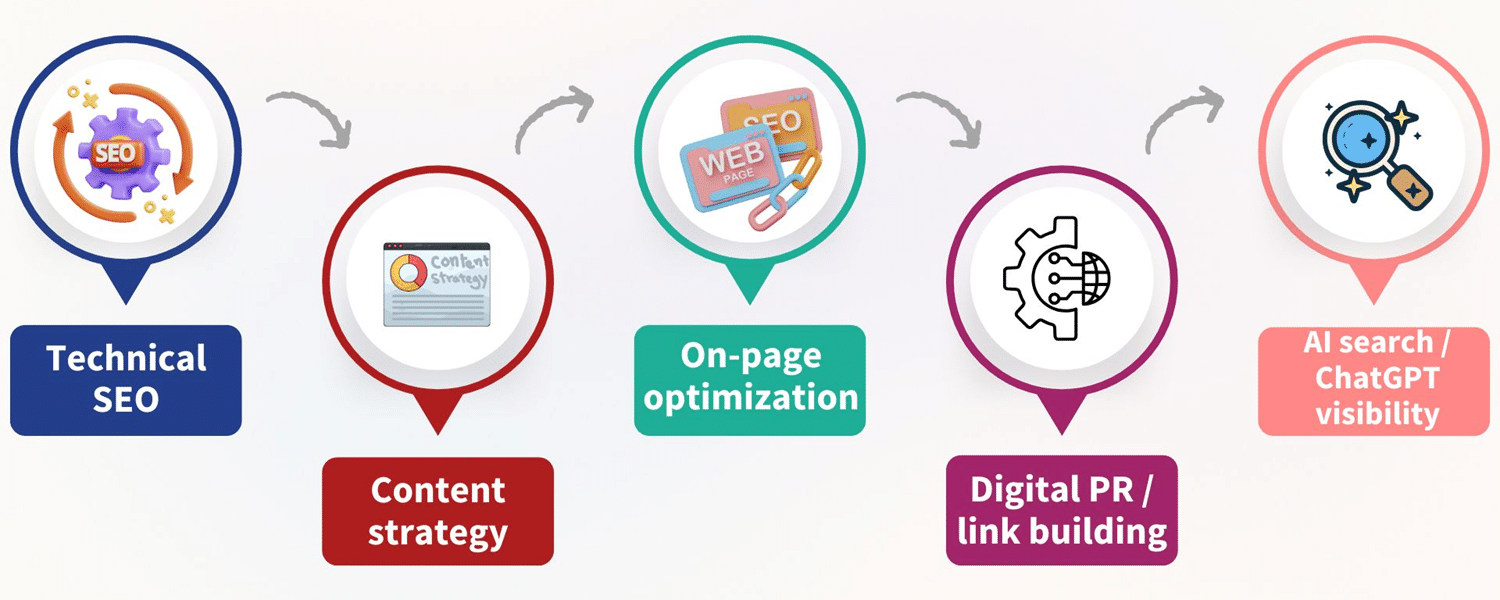
Whether you use a tool or an agency, the core building blocks of SEO are the same:
- Keyword & topic research – understanding what your customers search for
- On-page optimization – optimizing pages, titles, headings, content, internal links
- Technical SEO – site speed, crawlability, indexation, structured data, fixing errors
- Content strategy & creation – blogs, landing pages, FAQs, guides
- Off-page / authority building – backlinks, mentions, digital PR
- Analytics & iteration – tracking rankings, traffic, leads, and improving over time
Now there’s a new layer: AI search – visibility on tools like ChatGPT, Gemini, and other AI assistants. Many modern SEO tools and agencies now think in terms of both Google and AI answers.
With that in mind, let’s look at AI SEO tools first.
Ready to leverage AI search for your business growth?
What are AI SEO tools?
AI SEO tools are software platforms that use machine learning / AI to automate or speed up parts of SEO.
Typical features include:
- Keyword and topic research
- Content briefs and outlines based on top-ranking pages
- On-page optimization suggestions (what to add, word count, related topics)
- AI-assisted content writing
- Technical audits (finding missing tags, broken links, speed issues)
- Performance dashboards for rankings and traffic
- Newer tools also track AI search visibility – how often your content appears or is referenced in AI answers.
Think of them as very smart dashboards and assistants:
they surface data, automate checks, and suggest what might work.
The upside: where AI SEO tools actually help
For a small business, AI SEO tools do have real advantages.
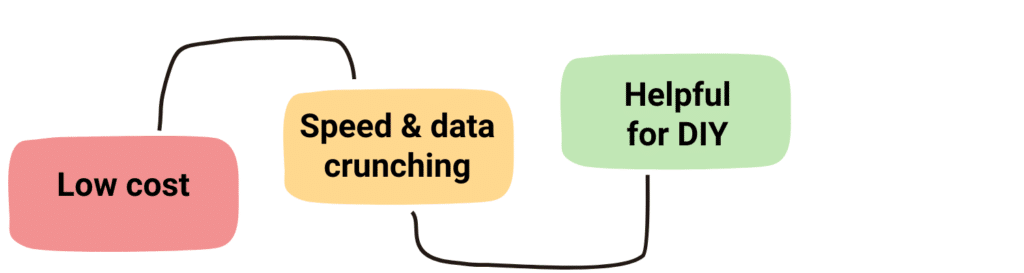
1. Low entry cost compared to a full team
Most tools have tiered pricing. You might pay the equivalent of a couple of dinners out per month for access to serious SEO capabilities, instead of hiring an in-house SEO or paying a full agency retainer.
If you’re at an early stage and cash is tight but you have time, this is attractive.
2. Speed and data crunching
AI tools can:
- Analyze dozens of top-ranking articles in minutes
- Suggest semantically related keywords and entities
- Run technical checks across a large site faster than a manual audit
They’re very good at finding patterns in data quickly and turning that into checklists and recommendations.
3. Helpful “guardrails” for DIY SEO
If you like to write your own content or tweak your own site:
- Content tools can show you the topics you’ve missed
- Optimization tools can nudge you to improve headings, structure, internal links
- Technical reports can highlight obvious issues to fix
For owner-led or very small teams that enjoy learning, AI SEO tools can feel like having a coach sitting next to you, pointing at what to improve.
The catch: why AI SEO tools often disappoint in practice
Now the part many sales pages gloss over.
On our side, we’ve worked with clients who first tried to “just use AI tools” for SEO because:
- They’re cheap
- They don’t need follow-ups
- The dashboards look impressive
A few months later, they moved to an agency model. Not because tools are useless, but because tools without dedicated time and human judgment ended up doing very basic SEO and missing real opportunities.
Here’s why that happens.
1. Tools are powerful, but not 100% automatic
AI SEO tools are still tools.
They work on parameters, settings, and inputs you give them. If you:
- Don’t configure them properly
- Don’t feed them correct priorities
- Don’t spend time implementing their recommendations
…then they will just keep running automated checks and scoring things in the background, without moving the needle.
Most small business owners simply do not have 5–10 hours every week to:
- Learn the tool
- Interpret its suggestions
- Decide what matters
- Implement changes
- Test and iterate
So the tool quietly becomes an expensive report generator that no one acts on.
2. Static checklists vs dynamic real-world SEO
AI tools usually operate with a pattern + checklist mindset:
“Top 10 ranking pages use these keywords, this structure, this length – copy that pattern.”
That’s useful, but real SEO in the wild is more dynamic:
- Your competitor changes pricing or product positioning
- Google releases a core update
- A new AI answer mode surfaces different types of content
- Your own business strategy shifts (new markets, new services)
A human SEO sees these changes, talks to you, and may say:
“Yes, the tool says write ‘X’ article, but your customers keep asking ‘Y’. Let’s prioritize that instead, and here’s why.”
Tools don’t sit in your sales meetings, read customer emails, or understand your margins.
3. Quality and accuracy issues with AI-generated content
Many AI content tools can now write full blog posts or landing pages. Helpful, but there are real drawbacks:
- They can introduce inaccurate claims or made-up stats
- They tend to sound generic, especially in competitive niches
- They often echo what competitors already say, which doesn’t help you stand out
Search engines and users are both moving toward content that is helpful, original, and grounded in real experience. Purely tool-driven content often fails that test over time.
4. No real “ownership” of your SEO
Perhaps the biggest hidden drawback:
AI tools don’t own outcomes – you do.
If rankings drop, content doesn’t convert, or AI answer engines ignore your brand, the tool doesn’t sit with you to rethink your strategy. It just keeps producing reports.
For a busy small business, that gap between “insights” and “done” is where things break.
What does outsourcing SEO to an agency actually mean?
When you outsource SEO to an agency, especially a specialist SEO shop, you’re not buying a dashboard. You’re buying:
- A team – technical SEO, content, keyword research, link building, analytics
- A strategy – tailored to your business model, margins, markets, and goals
- Execution – the actual doing: fixing, writing, publishing, optimizing, reporting
- Iteration – seeing what works, doubling down, dropping what doesn’t
A good agency will use tools (including AI) behind the scenes, but their value is in deciding what to do and then actually doing it consistently.
Advantages of outsourcing to an SEO agency
1. Deep, cross-functional expertise
Most small businesses can’t hire separate people for:
An established SEO agency brings all those skills as a package, usually at a lower cost than building an in-house team.
2. Your time is freed up
Instead of:
- Learning yet another tool
- Reading long audit reports
- Writing / editing content yourself
- Manually checking rankings
…you get summary insights and clear actions from the agency.
Your job becomes:
“Review, give business context, and make decisions”
Not:
“Configure, execute, and troubleshoot everything yourself.”
For owners juggling operations, sales, hiring, and delivery, this is usually the biggest benefit.
3. A human brain watching patterns and context
ood SEO agency doesn’t just say, “Tool shows keyword gap, let’s fill it.”
They might say things like:
- “Yes, this keyword has search volume, but those leads won’t be profitable for you.”
- “We see Reddit threads and Q&A communities where your brand should show up.”
- “People ask different questions in the UAE vs US – let’s split content by geography.”
- “Your competitors are getting cited in AI answers for this topic, but not you. Here’s a content plan to change that.”
That kind of reasoning comes from combining:
- Tool data
- Real-world experience across multiple clients and industries
- Constant observation of search results and AI assistants
4. Tools + people, not tools or people
Most serious agencies now use AI SEO tools heavily – but as accelerators, not replacements:
- Tools handle audits, briefs, clustering, and competitive scans
- Humans handle strategy, brand voice, prioritization, and quality control
So you’re effectively renting “humans + tools + process” in one monthly fee.
5. A quick, real-world example (from our own work)
To make this less abstract, here’s a real example from our own work at Growth Accelerators, a trusted SEO outsourcing company in India.
We partnered with a high-end landscape designer who wanted to reach more homeowners searching for premium garden and outdoor design services. Before working with us, they had tried using SEO tools on their own – they had some reports and keyword ideas, but no real, consistent movement in rankings or enquiries.
When we came in, we focused on a few core things:
- Clear local SEO strategy:
We mapped out the exact service + location combinations that mattered most (“landscape designer + [city/area]”) instead of chasing every generic keyword. - Site structure and on-page work:
We restructured key pages, tightened up titles and headings, improved internal linking, and made sure each page clearly matched a specific search intent. - Content built around real questions:
Instead of only following tool-generated topics, we combined that data with the questions the client actually heard from prospects and built content to answer those. - Authority and trust signals:
We worked on building the right kind of mentions, citations, and backlinks that made sense for a design business targeting discerning, high-budget clients.
Over the next few months, this approach led to strong improvements in first-page visibility for their priority keywords and, more importantly, a steady lift in qualified enquiries coming through search.
This is one of our own SEO case studies, and it reflects how an agency typically works in practice:
- Yes, we used SEO and AI-powered tools in the background.
- But the real impact came from human decisions about positioning, keywords, and content – and from consistent execution month after month, which most small business owners simply don’t have the time to drive on their own.
Limitations of outsourcing to an agency
To stay neutral, we should also be honest about where agencies are not a perfect fit.
1. Higher upfront monthly cost than a single tool
Even with offshore agencies (for example, teams in India working for US/UK/UAE clients), a good SEO retainer is still more expensive than a single tool subscription.
If your budget is extremely limited and SEO isn’t yet a primary growth channel, you may not be ready for a long-term engagement.
2. You still need to engage
SEO is not 100% “set and forget” even with the best agency. You still need to:
- Share inputs about your business, products, margins, and ideal customers
- Approve / review content for accuracy
- Tell them what’s happening on the sales and operations side
If you never respond, even a strong agency will struggle.
3. Quality varies a lot between agencies
There are excellent agencies and there are checkbox-style vendors.
A weak agency can:
- Over-focus on vanity metrics
- Deliver low-quality content
- Rely only on basic tools without real strategy
So picking the right partner (wherever they’re located) matters more than just choosing “agency vs tools.”
Here is an expert led guide for your reference to choose the right SEO agency, click here
Want an expert to guide your SEO strategy for better visibility?
Side-by-side: AI SEO tools vs outsourcing to an agency
Here’s a simple comparison, especially for small businesses:
| Factor | AI SEO Tools (DIY) | Outsourced SEO Agency |
|---|---|---|
| Monthly cost | Low–medium (tool subscriptions) | Medium–higher (retainer), but includes tools + team |
| Your time required | High – you drive everything | Medium – reviews + inputs, agency executes |
| Skill requirement | You need to learn SEO and the tool | You need basic SEO understanding, agency brings depth |
| Strategy & prioritization | You decide; tools only suggest | Agency designs and adjusts strategy with you |
| Consistency of execution | Depends on your discipline and time | Processes, deadlines, and teams keep things moving |
| Adaptation to your business | Limited; based on generic patterns | High, if the agency is good and collaborative |
| Best for | Very early-stage, hobby projects, or DIY enthusiasts | Small businesses serious about compounding SEO growth |
How to decide what’s right for you
Here’s a practical way to think about it.
Question 1: Do you have more time or more money right now?
- More time than money:
Start with 1–2 good AI SEO tools, learn the basics, and implement manually. Accept that progress may be slower, but you’ll understand your SEO from the inside. - More money than time:
An agency is usually more realistic. Tools alone won’t help if no one has time to drive them.
Question 2: How central is SEO to your growth?
- If SEO is “nice to have”, and most of your business comes from referrals or outbound, tools + light experimentation might be enough for now.
- If SEO is meant to be a primary growth engine over the next 12–24 months, relying on occasional DIY with a tool will probably not be enough.
Question 3: Do you already have SEO skills in-house?
- If someone on your team understands SEO well and enjoys it, AI tools can massively amplify their work.
- If no one does, the learning curve plus tool complexity can easily eat up months with little to show for it.
The realistic middle path: humans + AI working together
The future of SEO is not “humans vs AI” – it’s very clearly “humans + AI.”
For many small businesses, the sweet spot looks like this:
- Use AI SEO tools for:
- Faster research
- Content briefs and outlines
- Technical scans and issue detection
- Tracking your presence in Google and AI answer engines
- Faster research
- Use an SEO agency (or consultant) for:
- Overall strategy and prioritization
- Translating tool outputs into a focused plan
- Creating and editing content that sounds like you
- Handling link building, local SEO, and complex technical fixes
- Regular reviews and course-correcting when things change
- Overall strategy and prioritization
You’re not choosing between technology and people. You’re deciding who should sit in the driver’s seat:
- You, using AI tools directly, or
- A human team, using AI tools on your behalf
Both are legitimate choices. It depends on your stage, bandwidth, and ambition.
Wrapping up: choose based on reality, not hype
If you’re a small business owner in the US, UK, UAE, Australia, Canada, Spain or elsewhere, and you’re torn between:
- Paying for yet another AI SEO platform, or
- Outsourcing SEO to an experienced agency (whether local or in India)
Here’s the simplest way to decide:
If you enjoy getting into the weeds of SEO, have time every week, and your budget is tight – start with AI tools.
If SEO is mission-critical, your time is limited, and you want compounding results – work with an agency that uses AI tools and human judgment.
If you ever reach the point where you’re thinking, “We’ve tried tools, but we’re not getting the traction we hoped for,” that’s a good moment to at least talk to an agency and understand what a hybrid, human + AI approach could look like for your business.
And if you’d like a neutral, practical opinion on whether you actually need an agency or can stick with tools for now, the team at Growth Accelerators, we are always happy to look at your current setup and give you an honest view, no pressure, no hard sell, just a clear explanation of your options.
Claiming Your Google Brand Profile: Everything You Need to Know
Did you receive an email from Google Merchant Center about claiming your new Brand Profile?
Incase you did, we will take you through the process of claiming your Brand profile and explain it helps maximize your presence on Google search.
If you haven’t – don’t worry. Brand Profile is currently a beta feature by Google, and selected brands are being invited to claim their profiles before it rolls out fully.
Growth Accelerators: Top SEO Outsourcing Agency in Gurgaon For SMBs
The internet has become the new marketplace. Whether you’re buying shoes, booking a service, or searching for a nearby café, it all starts online. In this fast-moving digital world, it’s not enough for businesses to exist. They need to be found, understood, and trusted. That’s especially true for small and mid-sized businesses, who often don’t have massive budgets or marketing teams but still want to grow and compete. That’s the world Growth Accelerators stepped into; a small company in Gurgaon, started with a simple vision: to offer data-driven SEO strategies that actually help businesses grow.
Why Your Ranking Strategy on ChatGPT Should Vary by Industry
Trying to get your business or brand discovered on ChatGPT?
Here’s a key insight: Your approach needs to be tailored to your industry and how ChatGPT processes information in that particular category. Let’s break it down.
Step-by-Step Process to Generate a Sitemap and Submit It to Your Website and Google Search Console
Understanding and submitting your sitemap is crucial for SEO success. A sitemap tells search engines how your website is structured and which pages are most important. This guide walks you through generating a sitemap, submitting it to your website and Google Search Console, and resolving common errors.
Step-by-Step Guide to Set Up Google Merchant Center (GMC)
Google Merchant Center (GMC) is an essential tool for businesses that want to showcase their products on Google Shopping, Search, and other Google services. Setting up your GMC account correctly ensures better visibility and increases your chances of driving sales.
Here’s a step-by-step guide to setting up Google Merchant Center, common issues you may face during verification, and how to provide access to others.
Step-by-Step Process to Set Up Google My Business (GMB)
Having a well-optimized Google My Business (GMB) profile is essential for businesses looking to enhance their online presence. A GMB profile helps customers find your business, access essential details, and leave reviews. If you’re a business owner or marketer, setting up your GMB profile correctly can significantly boost your local SEO.
Here’s a step-by-step guide to help you set up Google My Business.
Step-by-Step Guide to Set Up Google Search Console and Grant Access
Google Search Console (GSC) earlier known as Webmaster, is a free tool by Google that helps monitor and troubleshoot a website’s presence in search results. It provides insights into indexing status, search queries, website performance, and potential issues affecting rankings, thus, a crucial tools used in Google Search Engine Optimization.
If you haven’t set up Google Search Console for your website yet, follow this simple guide to get started.
Step-by-Step Process to Set up Google Analytics GA4
Understanding your website’s traffic is crucial for business owners or marketers. Google Analytics is a powerful tool developed by Google that provides detailed insights into user behavior on your website. It helps you track where your website traffic is coming from, how long visitors stay, and whether they’re engaging with your content. You can also identify which marketing channels are driving the most traffic and conversions, whether it’s through Google organic search, paid ads, social media, or email campaigns.
In July 2023, Google shifted from the old version of Google Analytics (Universal Analytics) to GA4, which is the newer setup. Want to set up GA4 for your website?