Until recently, most buying journeys had one decision-maker: a human.
That is changing.
Now, shoppers can ask AI to research products, compare options, narrow down choices, and in some cases even move toward checkout. OpenAI has ChatGPT Agent, Google has “Buy for me” through Google Pay, and Amazon has Rufus inside its marketplace experience. These are not all doing the same job, but together they point to the same shift: product discovery is starting to move from search boxes and category pages into AI-led buying journeys.
This matters for brands because the product page is no longer speaking only to a human visitor. It may also be read by a system trying to decide what the product is, who it is for, whether it looks trustworthy, and whether it should be shortlisted.
Three real AI buying agents brands should pay attention to
1) ChatGPT Agent
OpenAI introduced ChatGPT Agent in July 2025. It can browse the web, carry out multi-step tasks, ask follow-up questions, and pause for user approval before consequential actions. OpenAI positions it as a system that “thinks and acts,” not just one that answers.
This matters because a user no longer has to manually compare ten tabs.
They can ask for something like:
Find the best travel backpack under a certain budget, compare features, check policies, and recommend the best option.
For brands, the implication is simple:If your page is crisp, specific, and comparison-friendly, you have a better shot of making the shortlist.
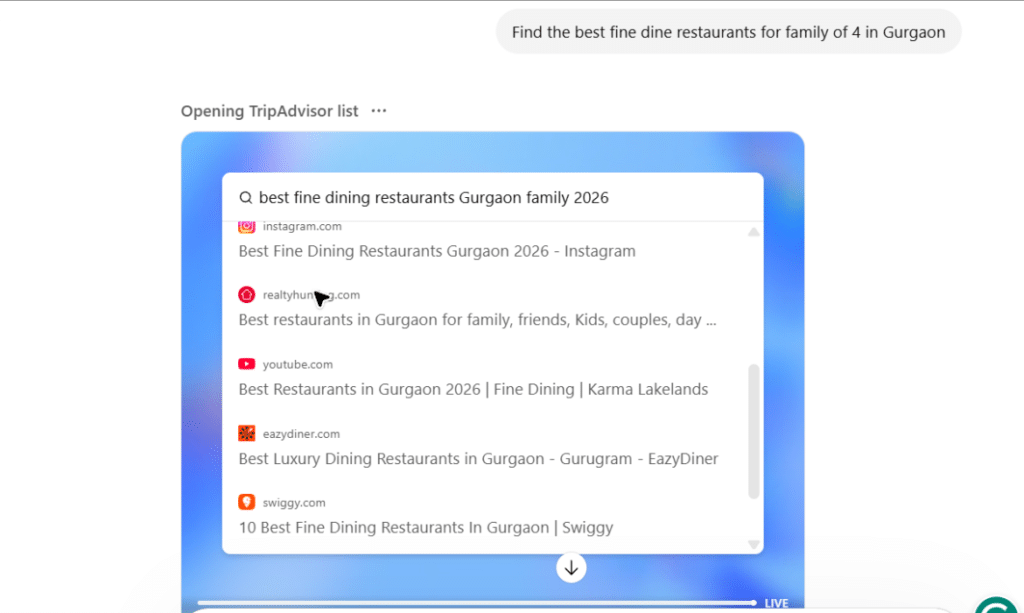
The below picture depicts real time example of “ChatGPT agent” running a search for a very specific query
2) Google “Buy for me”
Google announced its upgraded shopping experience in AI Mode in May 2025. The company said AI Mode would help users browse with guidance and reliable product data, and also introduced a new agentic checkout flow. A simple example: a shopper can track a product, wait for the right price, then confirm the purchase and tap “buy for me.” Google says the system then adds the item to the merchant’s cart and completes checkout securely with Google Pay.
So Google is moving closer to the transaction than a normal shopping search result.
It is a signal that product data quality, feed accuracy, price consistency, and checkout clarity will matter even more than before.
3) Amazon Rufus
Amazon launched Rufus in early 2024 and later expanded it to all U.S. customers in the Amazon Shopping app and on desktop. Amazon describes it as a generative AI-powered shopping assistant trained on Amazon’s product catalog, reviews, community Q&As, and information from across the web.
Rufus is the clearest example of an AI buying assistant that sits inside a high-intent shopping environment.
A customer is already on Amazon. They are already close to purchase. Rufus helps with questions like what to consider when buying, how products differ, whether something is durable, or which option is better for a specific use case.
That means Amazon listings now have another layer to win in. It is no longer only about ranking for a keyword inside Amazon search. The listing also needs to be understandable enough for Amazon’s AI to use it well.
The key difference: research-first vs buying-first
ChatGPT Agent is mainly research-first. It helps the user explore, compare, and decide. Google sits in the middle. It starts with discovery, but in some cases can move into agentic checkout. Amazon Rufus is buying-first. It lives inside a marketplace where shoppers already have purchase intent.
If the AI enters early, your content needs to explain clearly. If it enters late, your commerce data and transaction signals matter even more.
The trust wall is real
This shift is important, but it is not frictionless.
People are more comfortable using AI to research than to pay.There are good reasons for that.
Visa’s April 2026 research found that only 28% of consumers trust independent AI agents, versus 35% who trust payment-network-enabled AI and 36% who trust bank-backed AI systems. Visa also said consumers view trust and override capability as non-negotiable.
Capgemini’s 2026 consumer trends report adds to that picture: 76% of consumers want the ability to set clear rules for when an assistant acts, and 71% are worried about how generative AI uses their information. (Capgemini)
This shows that AI-led discovery is moving fast. Fully delegated purchasing is moving more carefully.
What we are advising clients to do now
As a specialised SEO agency, our advice is practical and grounded in how search and discovery are evolving.
Do not wait for this channel to become perfect before acting.
The smart move is to strengthen the inputs that both humans and AI systems rely on.
For ecommerce brands, that includes:
improving product title clarity
tightening PDP copy so the use case is obvious
making specs easier to scan
strengthening FAQs and comparison cues
cleaning up schema and merchant feed data
making pricing and availability consistent
improving review quality and review depth
reducing ambiguity in variants, shipping, and returns
For marketplace sellers, especially on Amazon, it means treating listings as AI-readable assets, not just keyword targets.
For brands selling through their own website, it means assuming that more shoppers will arrive after an AI has already filtered their options.
That changes what “good SEO” looks like. It becomes more tied to product understanding, trust signals, structured data, and buying clarity.
Final thought
AI buying agents are not replacing ecommerce. They are adding a new layer between the shopper and the product.
Sometimes that layer helps with research. Sometimes it helps with comparison. Sometimes it gets close to checkout. And in a few cases, it can complete the transaction path itself.
The opportunity is real. So are the limits.
That is exactly why brands should pay attention now!
The brands that will benefit most are not the ones chasing hype. They are the ones making their product pages clearer, cleaner, more structured, and more trustworthy before AI driven buying behavior becomes routine.